科创中国


会议直播已经结束
会议详情
报告名称:
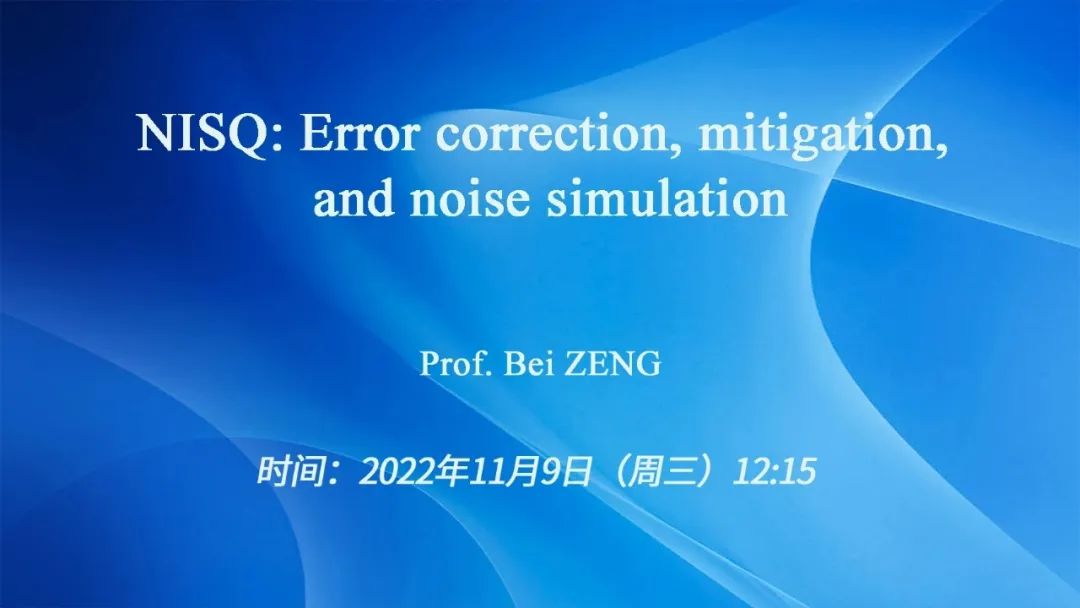
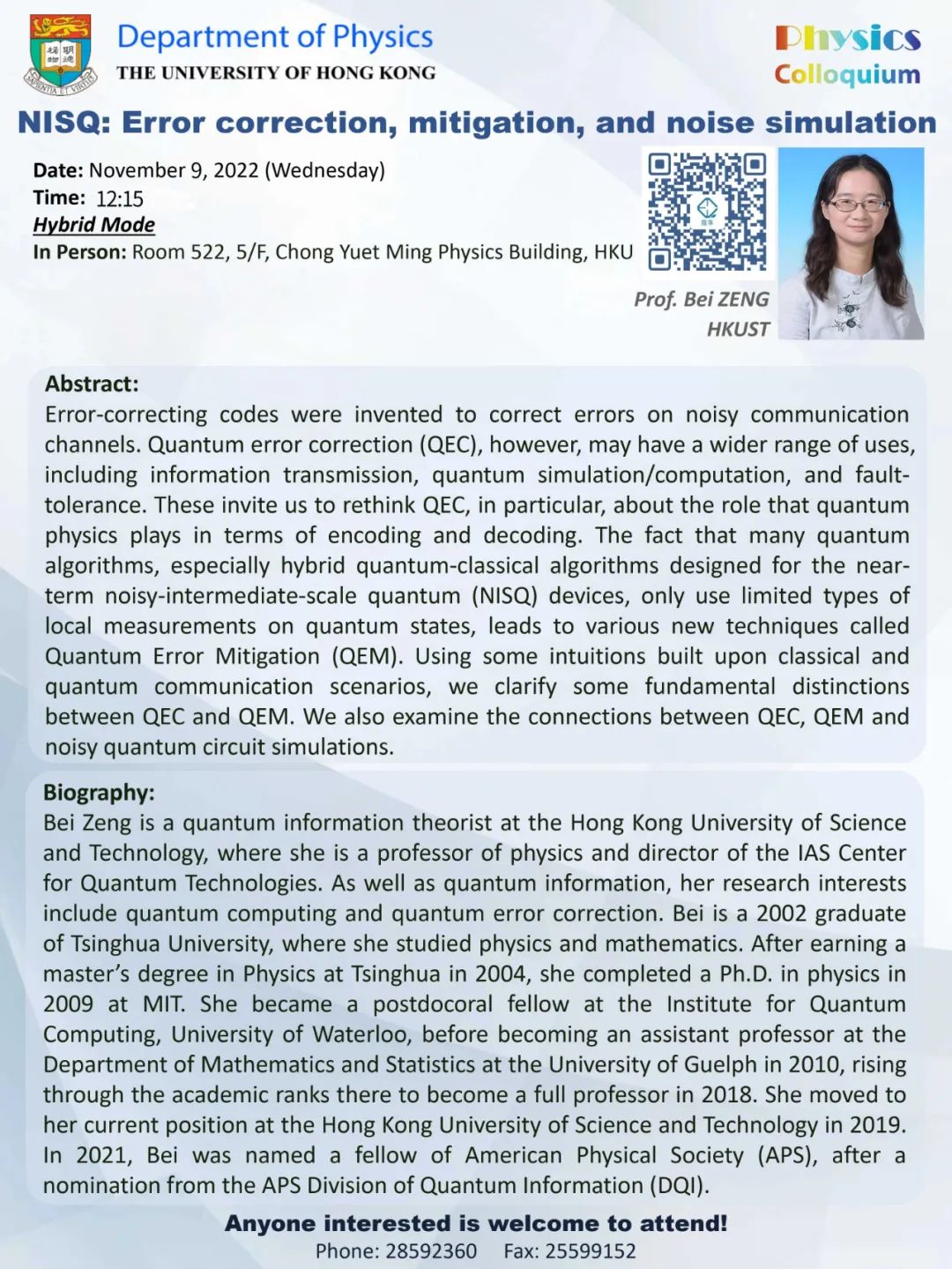
NISQ: Error correction, mitigation, and noise simulation
报告时间:
2022年11月9日(周三)12:15
报告嘉宾:
Prof. Bei ZENG
主办单位:
香港大学物理系
直播通道
蔻享学术直播间识别二维码,即可观看直播。
报告人介绍
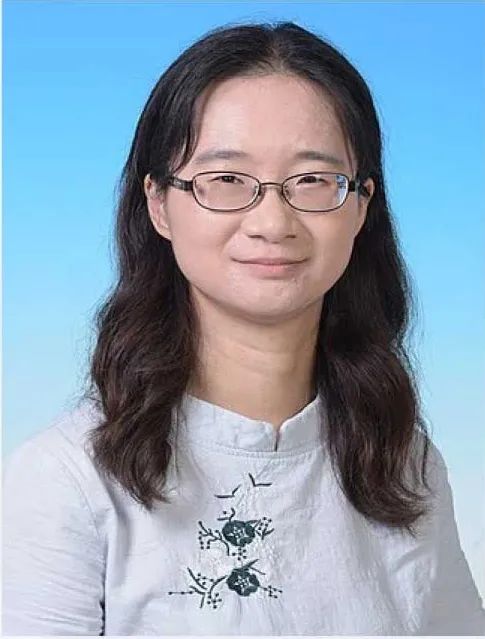
Prof. Bei ZENG
Bei Zeng is a quantum information theorist at the Hong Kong University of Science and Technology, where she is a professor of physics and director of the IAS Center for Quantum Technologies. As well as quantum information, her research interests include quantum computing and quantum error correction. Bei is a 2002 graduate of Tsinghua University, where she studied physics and mathematics. After earning a master’s degree in Physics at Tsinghua in 2004, she completed a Ph.D. in physics in 2009 at MIT. She became a postdocoral fellow at the Institute for Quantum Computing, University of Waterloo, before becoming an assistant professor at the Department of Mathematics and Statistics at the University of Guelph in 2010, rising through the academic ranks there to become a full professor in 2018. She moved to her current position at the Hong Kong University of Science and Technology in 2019. In 2021, Bei was named a fellow of American Physical Society (APS), after a nomination from the APS Division of Quantum Information (DQI)
报告简介
Error-correcting codes were invented to correct errors on noisy communication channels. Quantum error correction (QEC), however, may have a wider range of uses, including information transmission, quantum simulation/computation, and fault-tolerance. These invite us to rethink QEC, in particular, about the role that quantum physics plays in terms of encoding and decoding. The fact that many quantum algorithms, especially hybrid quantum-classical algorithms designed for the nearterm noisy-intermediate-scale quantum (NISQ) devices, only use limited types of local measurements on quantum states, leads to various new techniques called Quantum Error Mitigation (QEM). Using some intuitions built upon classical and quantum communication scenarios, we clarify some fundamental distinctions between QEC and QEM. We also examine the connections between QEC, QEM and noisy quantum circuit simulations.






 下载app
下载app